Your brain is running 10 background programs and nobody warned you.
You're not unpredictable. You're just executing cognitive biases with decades of research behind them — some as solid as bedrock, others not so much. We went and checked both kinds.
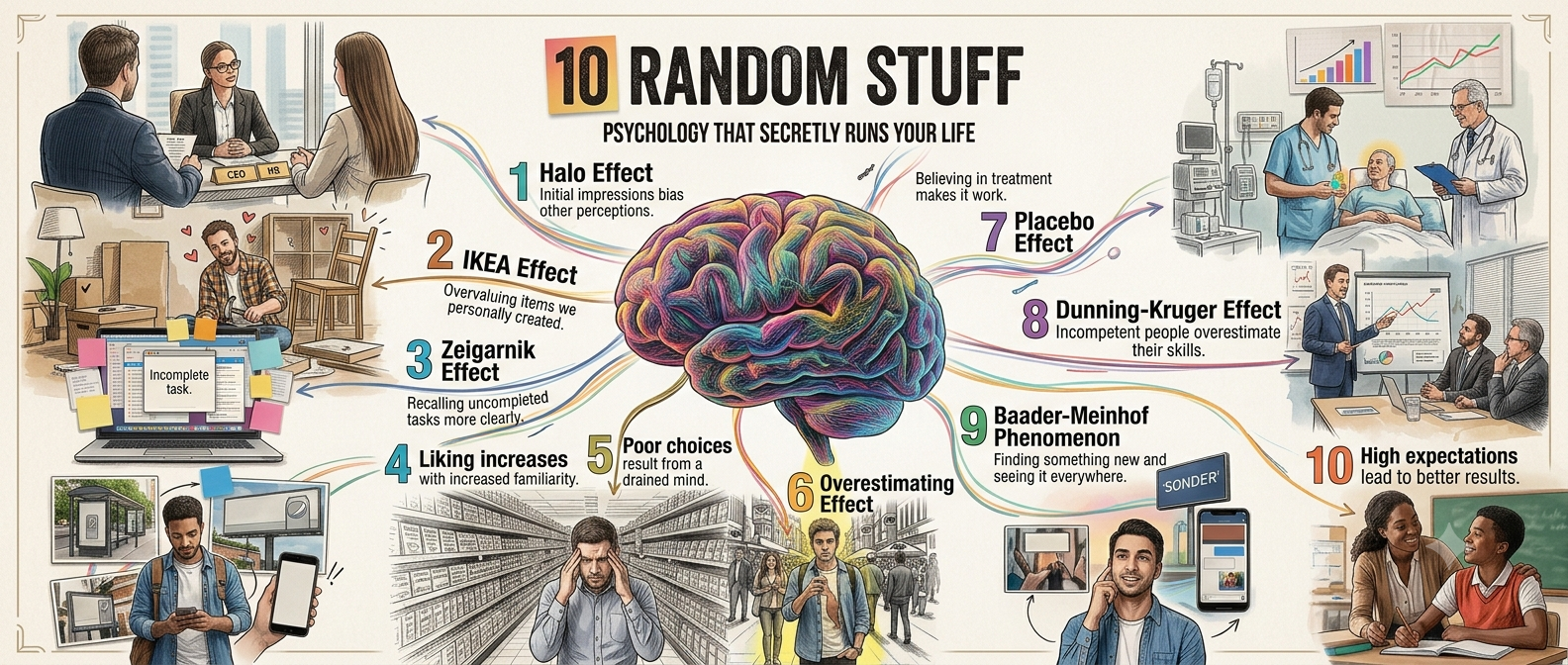
The crime map. Every arrow is a decision you swore you made on your own.
There's a version of you that picks outfits, buys furniture, judges coworkers, and decides who to trust — all while fully believing it's being 100% rational. That version doesn't exist. Never did. What exists is a highly efficient brain running shortcuts that psychology has been documenting since 1920, and most of them are still active inside you, right now, while you read this convinced you're immune.
We picked ten. We traced each one back to its original source. Some have survived decades of replication without a scratch. Others have recently taken a beating from science itself — and we'll tell you exactly which ones, because pretending certainty isn't our style.
Halo Effect
You meet someone attractive, well-dressed, and articulate, and your brain issues an instant promotion: must be smart too. Must be competent. Must be trustworthy. None of that was actually evaluated — it just feels like it was.
Edward Thorndike documented this in 1920 while rating military officers: whoever was seen as physically attractive was also, for no real reason, ranked as more intelligent and more capable in tasks that had nothing to do with looks. The effect shows up today in job interviews, school evaluations, and probably in your last purchase decision on a website with good product photography.

The first impression lasts 4 seconds. The judgment it contaminates lasts months.
IKEA Effect
You assemble the crooked bookshelf, with one leftover screw that definitely shouldn't be left over, and somehow love that bookshelf more than you'd love an identical one bought pre-built. It's not nostalgia. It's pure behavioral economics.
Michael Norton, Daniel Mochon, and Dan Ariely had people assemble IKEA boxes, fold origami, and build Lego sets — and found that effort alone increases the perceived value of the outcome. There's just one catch: the effect disappears if you don't finish the task, or if it gets destroyed afterward. Loving your own labor requires that the labor, at minimum, actually work out.
Zeigarnik Effect
The classic idea: unfinished tasks take up more room in memory than completed ones — the reason that unanswered email lives rent-free in your head at 2 a.m. Bluma Zeigarnik described this in 1927, after noticing waiters who remembered unpaid orders better than closed ones.
One study is nice. A century of attempts to replicate it is what actually counts — and here, they mostly failed. A 2025 meta-analysis pooling decades of attempts found no consistent memory advantage for unfinished tasks. What did survive was the sibling effect: the urge to go back and finish what was left hanging, even without remembering it any better.
"You don't remember what you left unfinished any better. You just feel an annoying pull to go back to it — and science is still figuring out why."
unHINGED — investigation noteMere Exposure Effect
You like that song more on the tenth listen than the first. You like the coworker who crosses your path every day more, even without exchanging ten sentences. Your brain treats "I've seen this before" as shorthand for "this is safe" — and "safe" quietly becomes "I like it."
Robert Zajonc proved this in 1968 using nonsense words, Chinese characters, and unfamiliar faces: mere repetition, with zero reward attached, was enough to raise preference. The effect is real, robust, and has a clear ceiling — it typically peaks somewhere between 10 and 20 exposures. Past that, more repetition can tip into boredom instead of affection.
Decision Fatigue
The popular version: every choice you make during the day drains a finite pool of willpower, which is why you toss random items in your cart at 9 p.m. just to stop deciding. The scientific version is a little more uncomfortable to admit: this theory, known as "ego depletion," sits at the center of psychology's replication crisis.
A 2016 multi-lab replication involving 23 labs found no effect. Later analyses pointed to publication bias in the original studies. More recent research (2024–2025) suggests the effect may be real, but only when the task is genuinely demanding — not for any small decision. Translation: your exhaustion at 9 p.m. is probably real. The "willpower battery" explanation the internet loves to sell you, maybe not so much.

The cereal aisle shouldn't demand this much from your prefrontal cortex.
Spotlight Effect
You trip, send an embarrassing voice memo, or notice a stain on your shirt mid-meeting — and spend the rest of the day certain everyone's thinking about it. Almost no one is. That's the spotlight effect: the tendency to overestimate how much other people notice and judge you.
Thomas Gilovich had Cornell volunteers wear an embarrassing T-shirt into a room full of strangers. They predicted nearly half the room would notice. The real number was far lower. The reason is simple: you're the center of your own mental universe, so you mistakenly assume you're the center of everyone else's too.
Placebo Effect
Believing a treatment will work can literally change your brain chemistry — even when the pill contains nothing at all. This isn't "the power of positive thinking." It's measurable neuroscience.
PET scan studies in Parkinson's patients showed real dopamine release in the striatum triggered purely by the expectation of receiving an effective treatment. The effect is strongest for pain, anxiety, and other subjective symptoms — and close to nonexistent for things like tumor size. Belief doesn't replace treatment. But it actively participates in how the body responds to it.

Half of any treatment's effect might live in here, not in the bottle.
Dunning-Kruger Effect
The version that became a meme: the less you know about something, the more confident you feel about it. It's a delicious line to pull out during a family group chat argument. It's also, according to a significant chunk of modern statistics, probably overstated.
Several researchers argue that much of the effect Kruger and Dunning observed in 1999 is actually a statistical artifact called "regression to the mean" — combined with the fact that almost everyone rates themselves slightly above average at almost everything. This doesn't fully erase the original idea, but it does mean "incompetent people don't know they're incompetent" is a weaker claim than the internet likes to admit.
Baader-Meinhof Phenomenon
You learn a new word, and suddenly it shows up in three conversations that same week. You buy a red car and start seeing red cars everywhere. The world didn't change. Your attention did.
Also called the "frequency illusion," the phenomenon combines selective attention (your brain starts filtering the world for that one thing) with confirmation bias (you count the hits and ignore the misses). The name came from a 1994 reader's letter about a 1970s German terrorist group — and yes, the irony of people starting to notice the phenomenon's own name everywhere after learning it did not go unnoticed.
"The universe isn't trying to prove anything to you. Your attention just decided, without consulting you, that this now matters."
unHINGED — investigation notePygmalion Effect
High expectations produce better performance — not because magic is real, but because whoever expects more from you treats you differently without realizing it: more attention, more patience, more chances to try again.
Robert Rosenthal and Lenore Jacobson told teachers, in 1965, that certain students (chosen at random) were "intellectual bloomers." Those students, months later, showed real IQ gains. The explanation wasn't genetics. It was behavioral: without noticing, teachers gave those students more response time, more smiles, more challenge. The reverse also has a name — the Golem Effect — when low expectations produce worse performance.
You're not irrational. You're predictable. And knowing exactly where the script is written is the only way to sometimes choose not to follow it.
Notice that not every item on this list carries the same level of scientific certainty — that's intentional. The Zeigarnik Effect, Decision Fatigue, and Dunning-Kruger are all facing real debate in psychology right now. That doesn't make them useless: it means they're hypotheses still being refined, not laws of nature. Being honest about that is, if anything, the opposite of weakness.
Keep investigating
More pocket-sized investigations, every week.
Behavior, culture, and science — kept short, never dumbed down. No clickbait, always sourced.
Sign me upKeep reading